Tuesday, April 16, 2013

Using Liquitex acrylic spray paint to alter a canvas color

I while back, I did this post that included a large painted canvas project that I was going to attach oval fabric shapes to. When I showed it to my husband he said it looked like waterlilies. That made me sad as that was not my intent.   But I did see where he was coming from.  So I embraced the idea, but the background color needed some help.  I removed the oval fabric pieces I had pinned to it, and thought this would be a great opportunity to try out some Liquitex acrylic spray paints I had bought.

Here are the colors I used, titanium white, brilliant blue, and brilliant purple.

 I worked outside as they are an aerosol paint and do give off a smell and particles. Here is my piece pinned to a big styrofoam board with painters plastic over it.  I had sewn pieces of fabric and lace to the canvas, then had painted over it (no gesso) a few months back. In person, the color looked like a muddy mottled greenish color. (It just looked wimpy and lifeless to me).

I sprayed water on the canvas, then started spraying the paint.  It was quick and easy and if I didn't like something I just sprayed over it with another color. The white was a little chalky and left little mist drops too, so I did not leave much white. I think they make a translucent white paint, so I may pick some up sometime to try out.

Here you can see some of the interesting color changes. Because of the sprayed-on water (and I did spray additional water on during the process) there are some drips that I think are great!  This whole painting session took all of 10 minutes. If I had mixed and brushed on paint, it would have probably taken an hour at least.

Instead of equally spaced out fabric ovals that I had originally planned, I will be adding semi-realistic water lilies instead. Right now I am planning on using some dyed silks for this.

I did try this paint on some other fabric pieces, but was not too happy with the look of them.  I will stick to canvas or paper in the future. I am excited to try this paint with stencils as I have seen other people's work with them and it looks great.  I don't want to wear a big respirator mask so I will have to wait until I can work outside again. It may be at least a week as we currently have about 12" of snow.

Finished Italy tin collage

For the second Saturday art club, back in March, we worked on collages/assemblages using Altoid tins. I finally completed my Italy inspired tin, here is the completed work.


For this tin I used the following items:
1. I transferred a photo of Italy using an inkjet print on transparency. I lightly misted watercolor paper with water (not soaking but very damp), and laid the transparency on top and used a brayer to help with the transfer. I glued the watercolor paper to mat board so it could be put in a shadowbox frame.
2. The gold paper was originally brown and from a discarded wallpaper book. I rubbed Golden brand gold paint on it with my fingers so the gold is on the ridges, but the recesses are still dark brown.
3. The postcard is from Italy, I had bought a huge pack of used postcards in Italy. Some had ugly pictures on the front, so I used it with the back of the card showing.
4. The tin is similar to an Altoids tin. I used a small butane torch (like the kind used to burn the sugar on creme brulee) to remove the paint and it now has a mottled black/brown color.
5. The hands were kind of like a spring loaded paper clip. I don't know where I found it. I don't know what they were originally for. I used my Dremel tool to cut the hands apart.
6. The picture is one I took in a church (it was actually in Germany, but I like the image).
7. For the decorative top, I cut a metal ring in half for my base and painted it black.  I glued on jewelry charms to make the gold decoration. I tried to glue these with metal glue (similar to E6000), but they would not stay in place so I ended up using Apoxie Clay on the back side, and when it was dry I painted the clay black. I added a wire at each end bent at 90 degrees to attach the decorative top to the box. I attached it and the hands with Apoxie Clay (and painted it black when it was dry).
8. The rusty doo-dad is from a flea market.
9. The tin and the doo-dad were glued on with E6000. The paper items were glued on with Golden brand gel medium (I like mixing soft gel medium with fluid medium so it is somewhat fluid).

There you go, a ton of things went into making this piece. Some of it was done a while ago, and was just pulled out of my collection for the project ( the inkjet transfer, the burnt tin, the cut hands). Other things were done specifically for the project (the gold rubbed wallpaper, the decorative top). All the parts combine to make a great piece!

Sunday, April 7, 2013

Gelli and gelatin printing, Second Saturday Art club

For this month's art club, we decided to do gelatin and Gelli plate printing. It's easy, it's fun, it's fast!

Some of us had Gelli plates, which are great, since you can just make prints whenever the mood strikes. These are rubbery reusable plates for monoprinting. This link is for the Gelli arts website where these can be purchased, I haven't seen them available at any craft stores. Their website also has a basic video on doing monochromatic prints, and I am sure there are videos on YouTube as well.

I have the 8" x 10" Gelli plate. For everyone else, I made gelatin for them to print on. The plate needs to be roughly 3/4" to 1" thick, so I measured how much water would fit in the pans I was using to make the gelatin.  The pans differed in size, some took 4 cups of water, some took 6 cups.  If I was making gelatin and using the pan that took 4 cups of water, this is the process I used.  I poured 2 cups of water in the pan and stirred in 8 packets of Knox unflavored gelatin (each packet is roughly 1 tablespoon of gelatin). I stir this to get the lumps out. I would heat the other two cups of water to a boil, then add it to the pan, and stir gently until all the gelatin is dissolved. I let this rest about five minutes, then use scrap paper to drag across the top surface to remove any bubbles.  The pan rests at room temperature about thirty minutes, then I put it in the frig overnight.  I pulled the pan out of the frig thirty minutes before I planned to use it. To remove it from the pan, I poured about an inch of boiling water into a larger empty pan, then set the pan with gelatin in this water. I run a regular kitchen knife around the edges. The boiling water will melt some of the gelatin and it will just plop out of the pan when you flip it onto a water proof surface (we used freezer paper).

Gelatin formula: X cups of water x 2 = number of gelatin packets needed. Mix half of the water (cold) with the gelatin, then add the other half of the water (boiling) and stir gently. Rest 30 minutes, then refrigerate overnight.

Sabyl brayering her Gelli plate. Typically we would brayer the entire plate with colors, then use rubber stamps, stencils, found objects to stamp into the color. If the item was pressed into the surface without paint on the item, it would remove the color from the plate. If the item was painted first, it would add that colored pattern to the plate.

Liz at her workstation with Gayla and Laurie in the back.

 We let our prints dry on plastic and newsprint in the adjacent hall, so I don't know which belong to who.


This is Simone's, she printed onto a 11x17 black and white photocopy. I love it!

 These are Laurie's.

I did some on paper (mainly maps).

And on fabric.
 This one is my favorite.

Gelatin printing is super fun. I did about 12 prints on fabric, and 17 on paper in roughly 3 to 4 hours. Many of these I did more than one layer of print. I would print it, let it dry, then print another layer (and some had three layers).  It is a great time!

Friday, April 5, 2013

Making textured paper with Paper Solvy

I wanted to add some patterned texture to a project I am working on. I decided to make some textured paper using paper solvy and textured items.

Supplies needed are: Sulky Paper Solvy, textured items (I used rubber stamps, stencils and two textured items), and a cup of water.


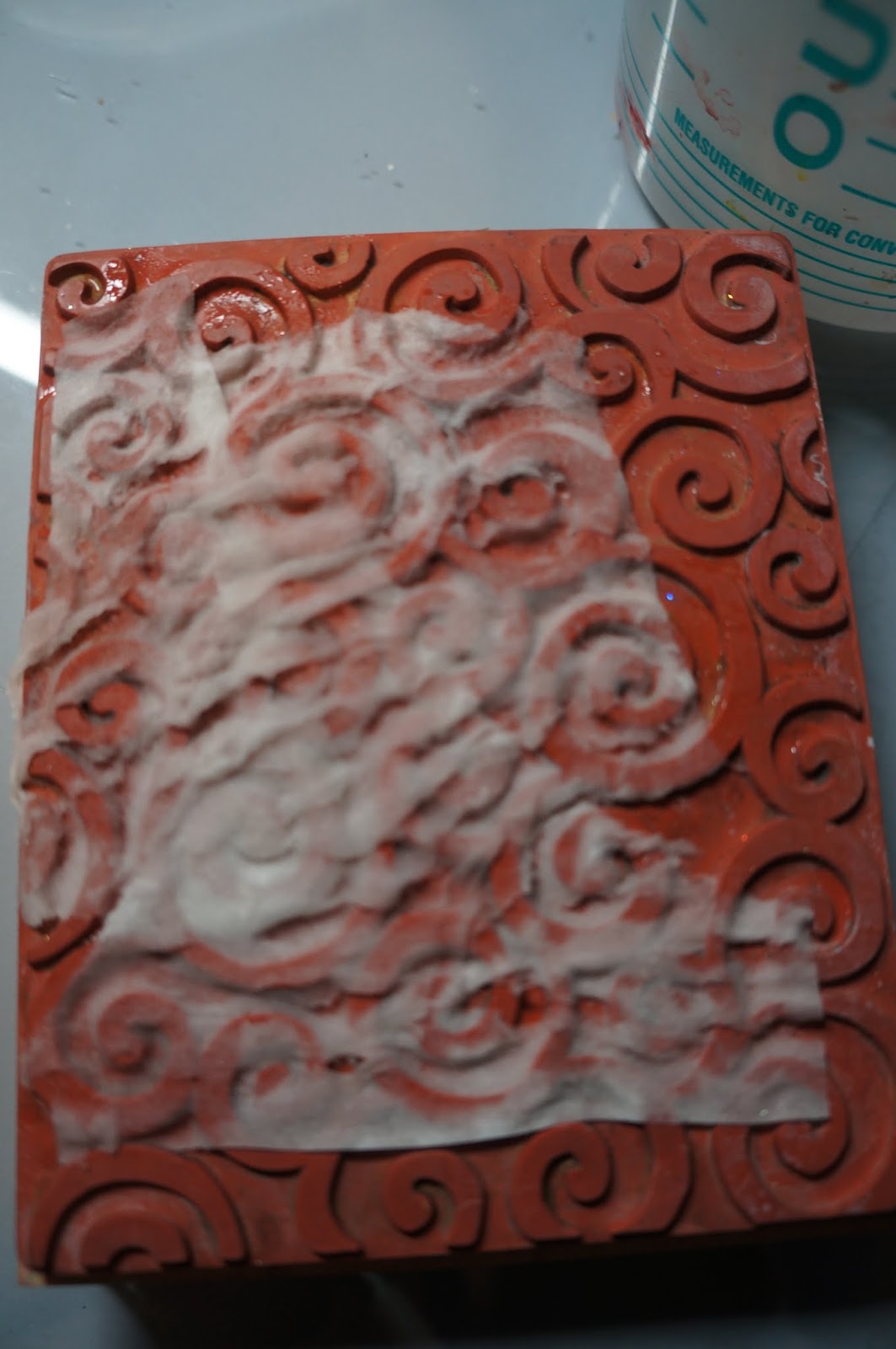
I rip the paper into smaller pieces, roughly 2" x 3", but it just needs to be smaller than the stamp or textured item. I wet my brush, run the brush along the edge of my water cup to remove some of the water, and wet the paper. If you use too much water, the paper will dissolve completely. I used a few layers of paper, so if I dissolve a hole in the paper, I just make sure to add more paper there to cover it. I do press the edge of my brush into the ridges of the stamp, especially on my first layer, so I will get a deep impression.

Here it is after a couple of pieces of paper are applied.

And here is the finished layers. I used about 3/4 of a 8" x 10" piece of Solvy for this one stamp.

I let it dry overnight and then peeled the paper off the plate.  This needs to be done gently so the paper doesn't tear.  They were slightly damp when I removed them, and curled up a little when they finished drying. I will mist them with just a touch of water and put them under a book to flatten them. If I mist them with too much water, the paper will dissolve, so it takes just a light spray.  

 I have used the swirl stamp for this technique before and love the results. The stencil did not leave a very distinct pattern since it is so thin, but will still be nice for a collage. The one from the dark gray plastic plate almost is too textured, but I will see how it looks after removing the bow in the paper.  (I should have put them under a book when I removed them from the plate to avoid having to re-wet them).

I have read that you can do this same technique with toilet paper, but I have never tried it. I just imagine that the toilet paper will disintegrate over time, but really I have no idea how well the Solvy will hold up.  When I go to paint these, I need to use a heavy body paint or need to coat with regular gel medium (or spray acrylic sealer) so the paper does not dissolve. If I used a watered down paint without a sealer, the paper will start dissolving.  I don't know which of these I will use in my project, but I will be attaching it to two sides of a block of wood. I can mist the back side of the paper and get the paper to curve around block, and it is going to look great! I hope to work on this piece next week!


Thursday, April 4, 2013

Fiber Art Exhibit, Poudre River Gallery, Ft. Collins

The Poudre River Gallery in Ft. Collins is having a Fiber Art show April 4th through April 27th.  I have two pieces in the show, shown below. If you are in the area and can make it to the opening reception, it is this Friday the 6th, from 6-9pm and I hope you can stop by! I will be there from 6 to 7.  They were hanging the show when I dropped off my pieces, and it looked amazing.

Mother Earth


Red Trees

Wednesday, April 3, 2013

Glueing wool sweater sleeves together

Back in December, I tried to layer multiple wool sweater sleeves and felt them together. The post can be seen here. It did not work well at all so I decided I would try gluing them together. I experimented with different types of glue, posted here.

Many months later, I am trying it on my sweater sleeves. I used Omni-gel which I watered down (I aimed for 50/50 but just eye balled it). I just used my hand to mix them together.

Here are my layered sweater sleeves from my attempt to wet felt them together. I am using this styrofoam cone as my base, which I wrapped with freezer paper (shiny side facing out). I did run my sweater arm assembly through a soak/spin cycle in the wash machine so they would be damp.

I took the sweater arm assembly apart and laid them on my workstation in the order they would be assembled. I did remove two of the original layers as I started running out of glue. There are still at least eight layers, I forgot to count. I put on the first sleeve over the cone, and spread glue on. I put another sleeve on, another layer of glue. I did not wear gloves for this as I don't mind getting a little messy, and am one of those people that enjoy peeling glue.  (I think this come from my childhood, my sister and I would pour Elmer's on wax paper, and when it was dry we would peel it up and cut them to look like fake finger nails.)  This was not a bright idea as the Omni-Gel does not peel off like Elmer's or gel medium. It did not want to come off at all, even with soap and water. It ended up flaking off but took about two days to get rid of all of it.  I hope this bodes well that it will hold my sweater sleeves together.

 
Here it is drying. I did this assembly process about a week and a half ago. The top part seems dry, but the bottom was not.  I set it on it's side, and will probably wait another two weeks to make sure it is really dry. In Colorado, things dry pretty fast. I want to cut the arm assembly into rings (like tree rings), so I want to make sure it is completely dry before I try cutting it.

Monday, April 1, 2013

Field trip to Texas

This past week we went to Texas to visit Allen's family. I snuck in some side trips while we were there.  I'll skip the family stuff and just give the fun artsy/touristy highlights.

We went to the Dallas arboretum and they were having their spring flower event. They had tulips everywhere. I don't think I've ever seen so many tulips in one place.


I thought this plant was very interesting and took a bazillion photos of it back lit. I thought it was decorative purple cabbage, but looking at these photos, it doesn't look very cabbage-like. (My mom takes photos as a hobby and mainly does flowers, so maybe she will let us know what it is).

We also went to the Kimball art museum in Ft. Worth. The special exhibit was Bernini statues, and Allen and I had gone to Italy last year and still have our fill of Italian sculpture. We did look at the regular exhibits, and while they do have one nice piece from a lot of different famous artists, none of them really blew my socks off (although the Van Gogh was lovely).  We also went to the Modern Art Museum which  was across the street, which was a bit more thought provoking. I chose the Kimball over the Dallas Art Museum, and with the special exhibit, I probably should have gone to the Dallas Art Museum since their special exhibit was Chagall.

The following day we went to the Dallas Aquarium, which was very nice. It has a walkway that you follow through the space and goes through different ecosystems. It feels very intimate. 

Yes, I did get this close to the jaguar, there is only a layer of glass between him and me.

We drove through Waco on our way to Houston. We pulled over on the side of the road so I could take photos of the blue bonnets, which is the state flower.

In Houston, we went to see the Menil Collection, as well as the gallery of Cy Twombly art and the chapel with paintings by Rothko that were nearby.  They did not allow photography which was a total bummer as I found the African art at the Menil very inspiring.  In college I had to do an art piece inspired by the African exhibit at the Virginia Museum of Fine Art (I went to college in Richmond). I will try to find a picture of my sculpture, but it will require me to look in the 1990 archives to see if I took a picture of it (like I have them organized, ha!).  I still really like the piece, but am not sure if it is in my parent's attic or just gone after so many years. I used nails in it and I still love to use nails in my work. I plan to go to the Denver Art Museum and check out their African collection, hopefully Sunday, and also visit their Georgia O'Keeffe exhibit.

On the way back to Dallas, we went to the 1st Monday flea market in Canton. I was hoping to find some good cheap junk for mixed media assemblage, but left fairly disappointed. There was not enough rusty junk, and what they did have was way overpriced. A lot of the booths were antiques, or upcycled junk that was already transformed into something nicer, or just plain new stuff. I did find some cowboy gift wrap paper for a cowboy piece of art I am working on.We did not have a lot of time there, so I do feel like maybe I could have found something special, but would not go out of my way to go back. The corn dog and funnel cake were delicious though!

On the plus side, I was driving through Loveland this morning and decided to check out a thrift store I passed on the main drag. In the back they had a separate building that had second hand hardware type stuff.  I needed some chain for my cowboy project (at least 6' lengths, preferably all different) and I hit the mother load. I also found a big bag of square nails, which I love the look of. And I got a rockin' deal.  So maybe that makes up for the tough luck in Canton.