Showing posts with label acid dyes. Show all posts

Tuesday, December 31, 2013

Dyeing a wool felt blanket

I have been reading the blog over at and then we set it on fire and in December they were talking about dyeing wool blankets. Of course, "dye" and "wool" grabbed my attention and I happened to find a cream wool blanket at the thrift store this week for $6. (In truth, I was pretty sure it was wool, but it had no tag so I did a burn test when I got home to make sure.)

I wanted to try to "confetti dye" some pieces, similar to Carol R Eaton's confetti dyed cotton fabric. Of course she was using Procion dyes on cotton, and I am using acid dyes on wool, but I didn't think it would be much different. Acid dyes are a bit more potent than the Procion dyes, so I expected fairly strong colors.

I cut a bunch of 16" x 16" pieces for some projects and also had some long strips. I soaked these in a mix of vinegar and water then wrung them out and put them in a bucket.

I plan on steaming the fabrics in plastic wrap bundles, and since I have nice new ivory counter tops in my kitchen, I set up a burner plate on a table in the backyard. (Yay for mid-50 degree weather in December!)  I needed to color and wrap my fabrics outside anyway, since I was using loose dye powder.

Here are my dyes, gloves, mask, mesh strainer, and plastic wrap.

Here is my burner, steam pot (for crafting use only) and a wool piece on two joined pieces of plastic wrap.

I sprinkled dye powders on the damp wool using the strainer. I found the strainer holes too big and got a lot of blotchy spots. Next time I might add a layer of cheesecloth (or similar) to slow down the dye sifting.

With dye sprinkles.


I put a piece of plastic wrap on top and then rolled it up in the plastic wrap that was underneath the wool. Here it is after steaming. It's pretty dark and I don't love the color combination.


On some of the confetti pieces, the backside was nice, but I find this one a bit boring.

I don't have any more "before" pictures of the other confetti sprinkled pieces. For this one, I did not put plastic wrap on top before rolling, I folded it in thirds, then rolled it, and then wrapped it in plastic wrap.
 

It looks pretty cool but I think it would be better if I used less dye.


 Back side:


This one looks like a 70's shag carpet to me. This one was folded in half, then rolled, then wrapped in plastic wrap.

 Back side:


I planned to steam all my packets at the same time and I was concerned that the confetti dyed pieces might be a disaster so I switched to liquid dyes. (1/2 tsp dye to 4 oz water and about 1 tbsp vinegar, which was probably not needed since the fabric was soaked in water/vinegar mix).

 Squirt, squirt.

Then I folded it and squeezed it to distribute the dye. I opened it to make sure there were no blank spots, then rolled it up with the plastic wrap trapped in the rolled fabric (like making stromboli). 

The results.

 
 This one was red and yellow squirts, which became orange during steaming. When I squeezed it, a bunch of extra dye came out and I mopped it up with the small rectangular piece below.


Leftover orangy-yellow dye from the piece above, plus some added Chartreuse.


These long strips were folded in half longways, then rolled or folded to become a small packet. Each side got squirted with a different color dye.


Here are all my wrapped fabrics ready for steaming. I steamed them about 45 minutes (with the lid on), and let the pot and fabrics cool for an hour afterwards.

I wasn't worried about them felting, so I rinsed them while they were still fairly warm. All of the liquid dye fabrics did not have any excess dye in them (their rinse water was clear). The confetti dyed fabrics had a lot of excess dye and I rinsed them in the sink for a bit.  I threw them all in the wash machine on delicate cycle with some Synthrapol detergent, then dried them in the dryer on low heat.
After steaming
After steam dyeing the packets, I made a pot of black dye and dyed a long narrow piece black.

I am looking forward to playing with these, but it will probably be a month before I have the time. (And I still have about 1/3 of the blanket left for some future project).

Wednesday, October 9, 2013

Making soy silk papers, and other fiber papers

This past weekend I made a lot of dyed soy silk and wool roving. I also have dyed nylon, bamboo, and tencel fibers in my stash that I had previously dyed. I wanted to try my hand at making soy silk papers.  I wanted to make wispy light soy silk papers. I also wanted to see if I could make wool roving papers that looked wet felted. I love how they all turned out.

Here is the start of the wool roving paper, the bottom layer was mostly soy silk.

Then I added wool roving, curly wool, nylon, and angelina fibers on top.

This is my try at wispy soy silk paper. It has some bamboo, tencel, silk, and angelina fibers as well.

I didn't take pictures of the other two pieces with the fibers laid out.

There is a towel and clear plastic protecting my table top.  The fibers are laid out on fine tulle and then another piece of tulle is placed on top. I then used a paint brush to apply hot soapy water (1/4 to 1/2 tsp hand dish washing detergent to 2 cups) to the fibers.  I don't want them swimming in water, I just want the fibers to be wet. Once the front looks good, I flip it over and do the back. (My instructions said wait 2 to 4 hours to make sure the fibers are saturated, but I don't think that is necessary. I did wait a bit, then continued). It seems most of the instructions I saw used Jo Sonja's Textile Medium, which I didn't have on hand. I used Golden's GAC 900 Textile medium.  I applied it with a brush, just on one side per the instructions I was using.  It worked really well. I think next time I will blot the fibers with a towel to remove some of the excess water first. Also, I think I would apply the medium to both sides, especially on the wool one.  I took them outside and hung them on a clothesline to dry (Put them in a plastic tub or similar to carry them outside, as mine were very drippy). Hopefully my shrubs and grass by the clothesline don't mine a coat of textile medium!  Once dry, I take the tulle off.  I need to iron all of them, but here are pictures of them un-ironed.

I didn't take a picture of laying out the fibers on this one.  This is all real silk, laid out in two layers and is very solid. I wanted to have a "control sample" of fiber paper made exactly per the instructions, but wish I would have made it wispy.

Somewhat wispy, this is miscellaneous fibers (bamboo, tencel, soy silk). The purply rectangular bits at the bottom are silk throwster's waste that I bought pre-dyed from Wild Heathers (I bought it at a fabric convention, but I'm sure they have a website, and they also have a store now near the Denver Art Museum).

This is the piece that I did show the fiber layout above.  This is some silk, tencel, bamboo, and soy silk. I love the wispy open look of this (although the colors don't blend as well as I hoped).


This is the wool/ soy silk piece. I really like both sides so I think I will play with this some more.

Wool Side:


Soy Silk Side:


I plan to try to make wool paper that looks like my wet felted landscapes. This is a much quicker and easier way to create a felted looking piece.  The wool piece isn't completely glued through, it seems like I could pull it apart into two layers (which could be interesting in itself), so I am going to wet it and apply textile medium again to hopefully create a better bond.


Monday, October 7, 2013

Dyeing soy silk (and some wool)

I wanted to make some "soy silk paper", sometimes called "silk fusion" and bought some white soy silk fiber at Fancy Tiger in Denver.  I wanted to try dyeing it.  Looking on the Internet, it says to consider soy silk like a protein fiber, like wool, not a plant fiber, like cotton.

Since I had experimented with dyeing fibers before, see links below, I thought I would try Kool Aid dyeing and Color Hue dyeing the soy silk.

Links to previous experiments:
     See here  for wool roving dyeing (and silk scarf dyeing) with Color Hue dye
     See here for bamboo dyeing with Rit dyes
     See here for bamboo dyeing with Procion MX dyes
     See here for Nylon dyeing with Kool aid
     See here for Tencel dyeing with Rit dyes

First I tried the Kool Aid dyeing. No fiber is safe when I am doing experiments so some wool and wool/silk blend roving also get in the dye. I also found a package of wavy wool I bought at a garage sale.

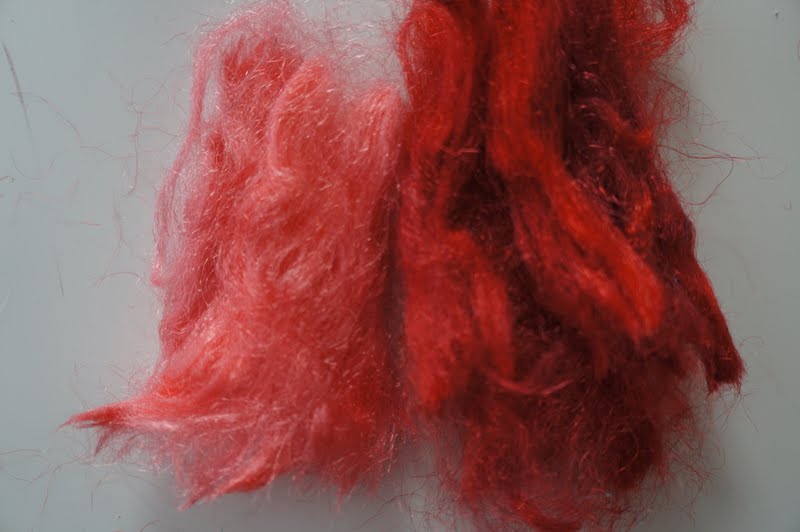
Fibers from left to right, soy silk, wool/silk blend, two types of wool (Merino and Brown? that is what is on the receipt, I bought these a while ago), and the wavy wool. I used 3 to 4 packets of Kool Aid for each batch. Please note that the Kool Aid is the color in the cup that Punchy is holding on the front of the package, not the color of the package itself. I had four purple packages that I thought were all grape, and it turned out I had two grape (purple) but two were some other flavor that was actually a gross red color. I didn't realize this until I had already stirred them all up in water and basically got maroon.
 I soak my fibers in water to help absorption and squeeze all the water out before putting it in the dye batch.

I mix my Kool Aid packets in a microwavable container with about a cup and a half of water. I pour a little vinegar on the fibers before they go in. Kool Aid is supposed to be "acid enough" without the vinegar, but it doesn't hurt.

Shove 'em in. Stir 'em a bit. I nuke it in the microwave for 2 minutes (lightly covered). I let it rest for at least 10 minutes. Sometimes that is enough for the fibers to take all the dye. The water should be clear or a cloudy white when all the dye is absorbed.  If there is still dye in the water, it can be nuked some more, but be careful as I don't think the soy silk likes the heat.  Nuke one more minute if necessary, and let it sit until cool.(Microwaves vary so I take no responsibility if you have problems or issues related to microwave dyeing.)

Here are my fibers cooling down. I don't want to rinse them while they are hot, as the wool may felt due to the quick temperature change. After they cool, I will rinse them well in cool water. If I feel they still have a lot of dye in them, I will let them sit in 2" of water in the sink, squeezing the fibers and changing the water every so often. The maroon took a ton of work to rinse out. 


While they are cooling, I am going to set up my other dyes.  These are Color Hue dyes and I got the sample set last Christmas. I have only seen these for sale on the Internet, and am pretty sure my set came from Dharma Trading. These are concentrated dyes, and I already have some mixed with water in small squirt and spray bottles.

I set up seven sandwich ziplock baggies and seven sets of fiber. Again, I wet my fibers before putting them in the baggies. I leave the fibers a little wet as this will help the dyes move through the fibers. These are considered instant set dyes, so after I add the dye (a healthy squirt into the baggie), I squeeze the bottom of the baggie with one hand, making sure the dyes don't try to escape at the top. If there are any white areas left on the fiber, I add more dye. I sometimes will squirt one color at one end and another color at the other to get a variegated color. The water is supposed to be clear when the dye is absorbed, but my water is never clear. I let them sit in their baggies for a few hours, squeezing occasionally. I then poured any remaining colored dye water into a large ziplock bag with some damp silk fabric since I didn't want the dye to go to waste (I had 3 silks each in a large baggy, one each for yellow/green, blue, and red dyes).


 Per the directions, after dyeing with Color Hues, I just need to rinse out the extra dye and then let them air dry.  I had issues with a previous batch, so I actually took these out of their baggies and let them air dry without rinsing then first. When they were dry I rinsed them, then let them air dry again.

Here is a picture of both the Kool Aid and the Color Hue dyed fibers.

Here are just the soy silks.  The ones on the left are Kool Aid dyed and they became curly/frizzy from the heat. The Color Hue ones still have smooth fibers. I did have problems with the soy silk not being completely dyed throughout. When I loosen the fibers, there are white patches that didn't get dyed. In the future I will spread the fibers before putting it in the baggy or container with the dyes.


 Soy silk: Color Hue dyed on the left, Kool Aid/microwave dyed on the right.

Next time, making fiber papers!

Monday, March 4, 2013

Dyeing a wool sweater for an art project

I have been wanting to make a 3D assemblage using a blue wool sweater. I planned to felt the sweater so it needed to be pretty big so it would look "regular size" after felting.  I could not find a sweater that would work, they were too small, not the right blue, etc.  I finally found one I thought was the appropriate size, and decided to try to dye it. This was a while ago, and I forget what I did, but instead of a nice blue sweater, with was muddy blue with blotchy gray spots. Recently, since I still did not find a new sweater that would work, I thought I would try to fix the dye job on the one I had. 

I did not expect good results so I didn't take any pictures before or during the process. First, I soaked the sweater in water, and wrung it out (I did not want any dry spots, so the remover would work uniformly). I made a bucket of Rit Color Remover outside (it is stinky stuff). I just used one packet of color remover and about one and half large steamer pots of boiling water.  Boiling water and wool typically is a bad thing, but I plan to felt the sweater so I am not concerned about it felting/shrinking. I let it sit in there for about an hour, then rinsed the sweater in the tub in the tub. The sweater was now roughly a heathered oatmeal color.

For the dyeing, I made a batch of about 1/2 tsp of Jacquard acid dye Turquoise in a big pot of water (pot is for crafting only, not cooking). I have been using too much dye powder in all my previous acid dyes so I only used 1/2 tsp as I did not want a dark sweater.  I cooked it on the stove for about a half an hour.  When I took it out is was more greenish than blueish. So I made another pot of dye, this time using Sapphire blue. I heated the dye pot on the stove and when it was hot, I took it off the stove and set it in the kitchen sink. I then dipped the sweater in the dye pot. . I would dip about 3/4 of the sweater in the dye and lift it partially out again.  I did leave about 1/2 the sweater in there it sit for a bit.  I did this dunking a few times, then I left about five inches of the sweater in the dye pot (for maybe a half hour?).

I got a great ombre affect, the very top of the sweater is still the greenish color from the turquoise bath, and then it goes into a medium toned Sapphire.

I hung it on the line to dry that is why it has a line across it. I plan on washing it on hot in the wash machine so it will felt a little more and to rinse out any extra dye. I sewed one sleeve to the sweater body with wool, as this is part of the art piece I want to make.


Friday, February 1, 2013

Dyeing wool yarn with Jacquard acid dyes

 I bought a couple skeins of this loopy wool for $1.85/ea. Hurrah! It was a bland tannish grayish color, and needed a dye job.

I soaked the yarn in water, squeezed the water out, then splashed some white vinegar on it. i mixed up some Jacquard acid dyes and used squirt bottles to apply them to my yarn. I left them in saran wrap for about a half hour to help the colors sink in and blend.  I then put them in ziploc bags and steamed the bags in my steamer dedicated to dyeing. I also included some silk/wool blend yarn as well. 

Again, I used too much dye and they ended up really dark. The time that I let the colors blend ended up with one color overpowering the other. The green at top left was supposed to be chartreuse and turquoise. The knitted section was to be green and golden yellow, but is orange. The red was supposed to be red and yellow. They still look really cool.  I had a little left-over dye and put some wool roving in with a mix of all the left-over dye. It has a nice variegated look.


Thursday, December 13, 2012

Dyeing Nylon fibers, with Kool Aid

I had bought an ounce of Nylon fiber at Fancy Tiger for $1.75/ounce. This picture doesn't do it justice as it is super sparkly.  Since Nylon is a man-made fiber, I decided to try to dye it with Kool Aid. It worked fabulously.
I mixed my Kool Aid packet with about a half cup of water in my plastic container designated for craft dyeing. I was worried about heating up the Nylon too much and it either melting or giving off gases (which would be extremely bad), so I added the fiber and only nuked it for a minute. It seemed to work great.  Here are my results. For the blue, I used the Iced Raspberry Kool Aid. For the dark one, I only used about a 1/2 cup of water. After removing the fiber, I added another cup and 1/2 of water and another piece of fiber and nuked it again.  I took that one out and added more water and another fiber and nuked it again. There is not much difference between the last two.  Red is Cherry. Orange is orange. The light one is a watered down orange, although it looks peachy-pink.Yellow is Lemonade. Obviously Kool Aid does not come in black. I decided to try Black Rit dye on one piece. It worked great and did not require a ton of rinsing to get the extra out, the way the Tencel did from yesterday's post. The only color that required two rinses was the red.

 I went to the grocery store and bought Grape Kool Aid as I wanted some purple fiber. Grape does not equal purple with Nylon. I got this weird maroon color, and a weird pink when I watered it down.  All the other colors were right on the money.

Shimmer and sparkle!