Monday, April 27, 2015

Cow Gelli prints

I have been wanting to make some "cow" art for a while.  Even before I moved to Nebraska, I was interested in them.

I've been really enjoying making my own stencils (see that post here), and thought I would make a cow stencil, and Gelli print with it.  I used a picture I took at the Nebraska State Fair last summer.


I decided that I needed two stencils, one a generic cow shape, and one a detailed outline stencil.  (Both of these pictures were taken after I printed with them)


I used the generic cow shape stencil to print backgrounds and the cows with colors and patterns. Most of these are three layers of printing, if not more.


When I print a second time on a previously printed one, I line the stencil up on the print, and tape the stencil to the paper with blue painter's tape. This worked pretty well to keep the prints overlapping correctly. You can see a few were off a little bit. Originally my plan was to keep these backgrounds simple, but the more layers I added, the more interesting they became.

After printing the base layers, I then printed the detail stencil, again aligning the stencil on the print, and taping the stencil to the paper.


I covered my gelli plate with black paint (Liquitex Basics), laid the stencil/paper on top, and used my fingers to press into the stencil cutout areas.

After pulling the stencil/paper off the gelli plate:
After I removed the stencil:

Since I had to leave "bridges" so my stencil would stay in one piece, there are spots I filled in with a paintbrush to give a bit more detail.


 Some of these prints are absolutely delicious. 

I love the way these turned out, but the detail stencil was difficult to work with. I think some of the details were just too small, and many times they did not get printed and I had to do paint touch-up. I purposely avoided cutting a mylar stencil, because it is easier to make a mistake than the cardstock/contact paper stencil, and I find mylar more difficult to cut.  Cutting this detail stencil took three episodes of CSI (now available on Hulu, yay!) and the tip of my index finger was numb for a week.  What I wouldn't do for a ScanNCut, or other stencil making machine. Maybe I will splurge on one in the future.

I do plan to mount six of these on one canvas, and may do three canvases like that, since I have enough prints.  The first print at the top of the page is my favorite, for my personal collection.  The background was just "brayer cleaning" paper from another project (I don't show the brayer-cleaning papers, but you can see the project they are from on my guest post on Julie Fei-Fan Balzer's blog).  I always save my cleaning papers and not-so-good prints, because another layer or two can make them amazing.

I did order a Thermofax of the detail stencil, and it's a bit smaller as the Thermofax can't come this big. I am looking forward to playing with it as it is the first one I've owned. And my index finger is thanking me for the break from detail cutting.


Wednesday, April 8, 2015

Goldfish felt wall art

I have been taking on online surface design felting class with Fiona Duthie. It has been great and well worth the cost.  I did have a few weeks when I was having issues with vertigo and did not complete all the technique samples, but I look forward to finishing them all.

For our last week of class, we are to work on a project of our choice using some of the techniques we learned, so I included techniques from the weeks' lessons that I was able to finish. 

When I first started felting wall art, I learned my technique from Moy Mackey's book, Art in Felt & Stitch. I still used a white base layer per Moy's technique, as I want my wall art piece to hold it's shape over time, and using many layers will accomplish this.
 After the white layers (2), I added corriedale wool in black, white, and blue, to add shading to next layer. But then I got carried away and added so many layers, this probably had no affect.
  More wool (this was a variegated merino I had purchased)
And more wool. I originally put this layer down before the "all over" variegated layer (which is what is pictured here), then I removed this layer, put the all-over layer down, then put these back down on top. I also included some glass gems and small round mirrors in the layers.
I wet these down, then added my goldfish and silk fabric "water".


Here is the felted piece. I need to iron it to help remove some of the wrinkles.
 Detail

Sunday, March 22, 2015

Collaged mirror with gelli prints

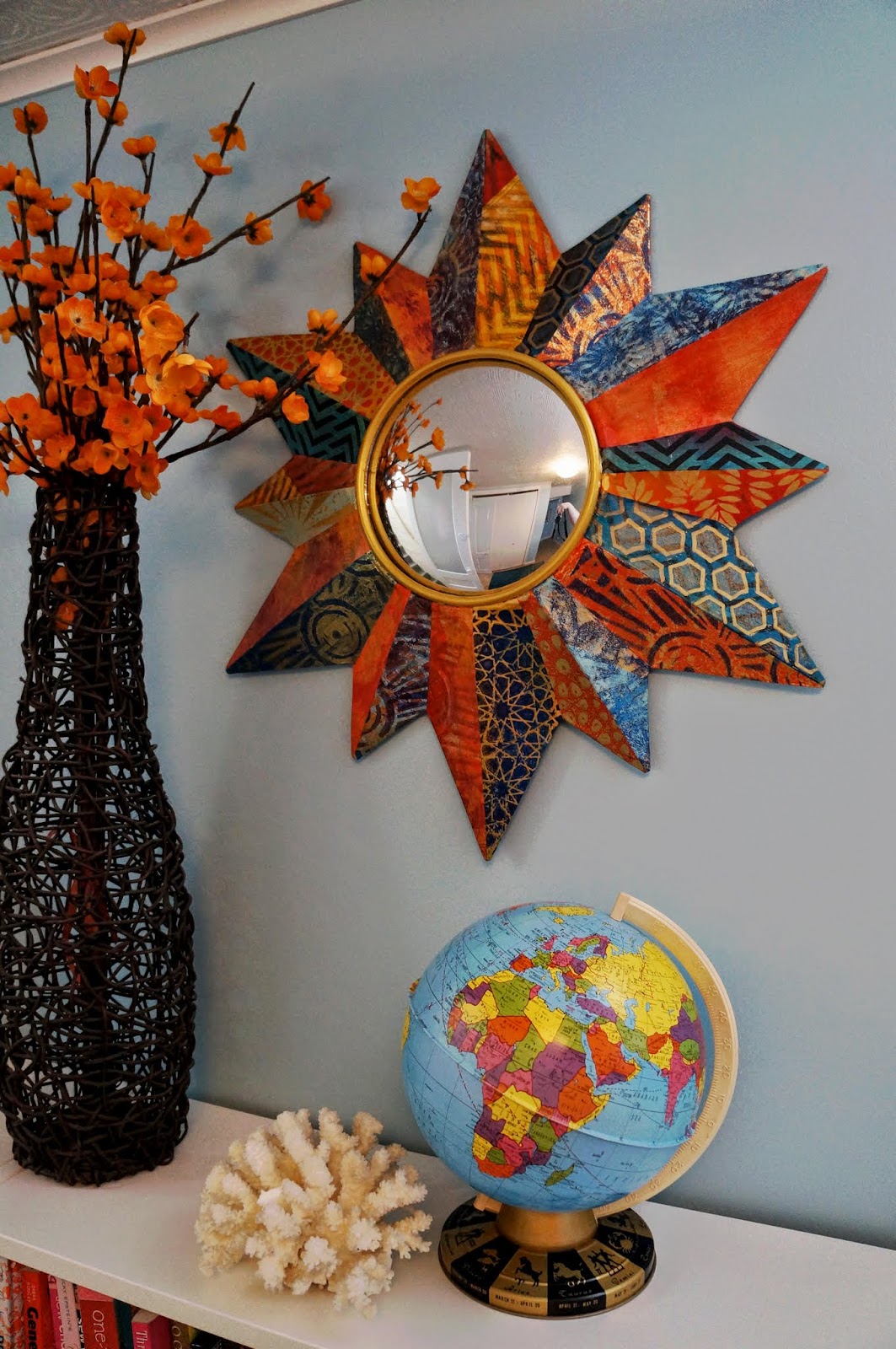
I bought this starburst mirror at the thrift store for $8 and decided to collage it with gelli prints. I knew I wanted it to be in the basement entryway, which we recently painted blue. Also, I plan to have some orange accents in the basement. I made a bunch of blue and red/orange gelli prints specifically for this project.

Here are my gelli prints cut out. I am alternating blue and orange pieces.

In progress. I painted the starburst gold before adding the gelli prints.

 Complete.

 Here is a shot of the completed mirror (I took this picture at night, so the lighting is a little off).

 Here it is  hanging in the entryway.

 (I photoshopped myself out of the mirror reflection. I hadn't dressed up for a selfie).


Thursday, March 19, 2015

Basement Entry renovation

We finally have the basement entryway done.


Here are some before shots of the basement entryway. This is one end. This wall had pressboard paneling and we had it replaced with drywall. We replaced the laminate floor with Alterna tile flooring. We repainted the ceiling and walls and changed out the light fixture.


This wall was unfinished previously. We moved the door to the bedroom here.


Here the new entry has been framed out for the door. The door used to be to the right and set back from the hall (where you see purple on the right side).


There was a small kitchenette at the other end, with a hallway between the two areas.  The sink was not hooked up anymore, and this seemed like wasted space to us. We decided to have this be a part of the adjacent room (which is my art room, but could be used as a bedroom). This increased the size of my art room dramatically. The wall on the left was removed and the hallway will end where the wall on the right is.

Original kitchenette (bathroom beyond).

View from adjacent room. You can see the kitchenette area (was on left) is now part of this room (picture taken from roughly same place as photo above).


The bathroom door is at the end of the hall on the right, and art room door is on the left.


Monday, March 16, 2015

Painted Fabric Collage

This summer I bought this roll of 36" wide canvas at a "going out of business" sale. They said they used it for displays. All I know is I got this huge roll for $5.  I have been wanting to do some paintings on raw canvas as well as some fabric collage so this was a great find.

I have also been buying all kinds of "vintage" fabrics and embroideries at thrift stores and garage sales. For this first piece I sewed down a bunch of them, laying them out in the same way I would for a paper collage.

Then I took some "vintage" plastic doilies and painted blue paint through them.  When I add watery washes of paint later on, this thicker paint will act like a resist. I also used a stencil to create the red circular pattern, and corrugated cardboard for the lines in the middle section. I did repaint the red circles by hand, because the way I "printed" the stencil, it ended up being a very thin application of paint.

I then painted the piece with Setacolor transparent paints, pinned stencils on top, and set in the sun to dry.  I think it turned out very nice.
Details.


This is the second piece that I worked on.  Here is my fabric collage.  I had done some wonderful leaf sun prints this past summer, and my plan was to add one to this after painting it.

I painted this with yellows and greens, and a homemade black which leaned toward being purple. It made for a nice complementary contrast to the yellow.
Detail.


I still need to add the sun print to the green piece. Both of these will be stretched around a 24' x 30" canvas, so they will be smaller than the full canvases shown here.

This canvas is very thick and trying to just sew straight lines on it was a pain since the piece was so big.  I don't think I will use this canvas if I plan any pieces with free-motion stitching as it is just too hard to move the fabric around while sewing.
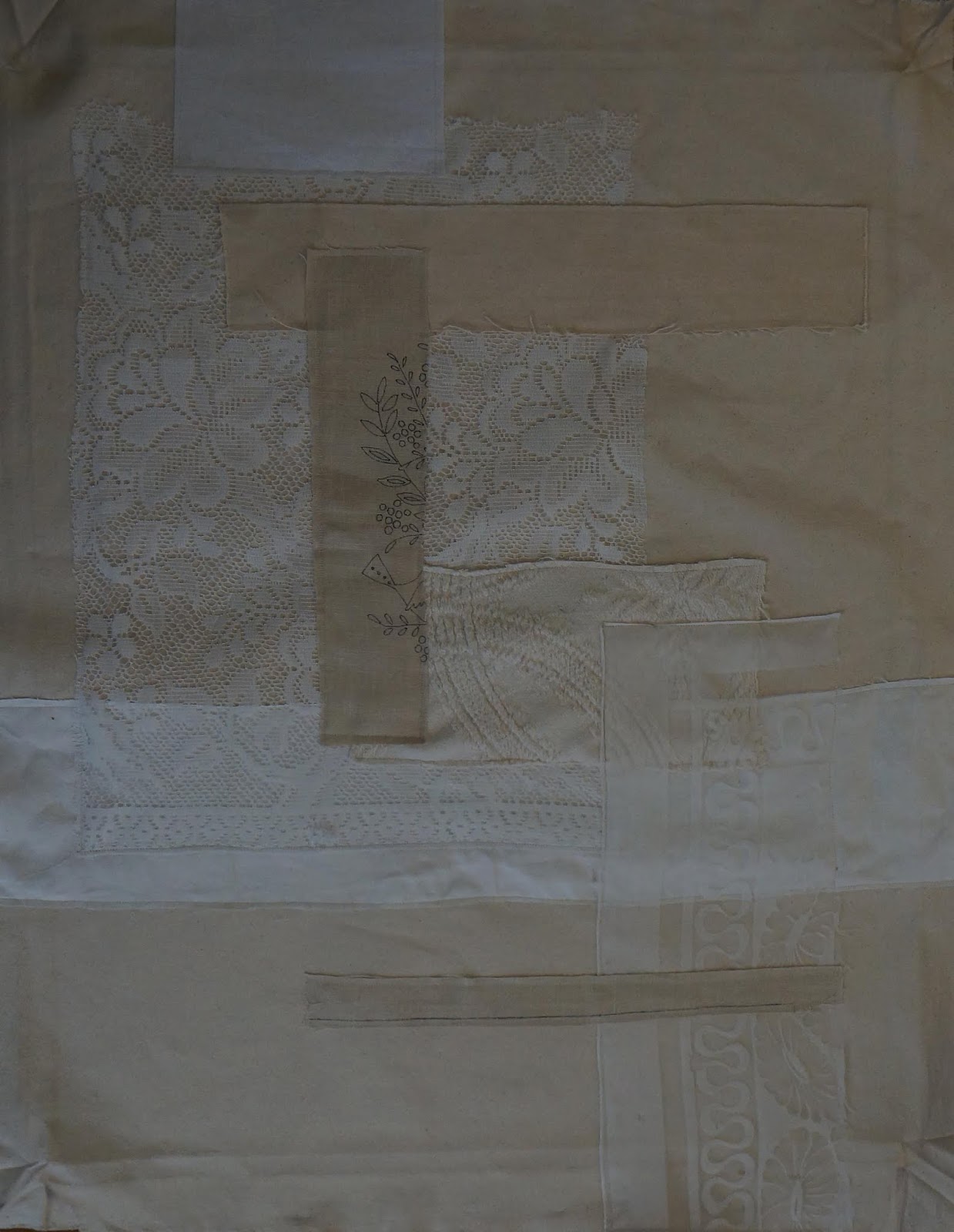
I do plan to do some smaller pieces that may are may not have fabric sewed on them.

I haven't blogged much recently as I had vertigo for almost two months, so I haven't been able to do much art lately. But I am feeling almost completely better and am so happy to work on projects that I have been thinking about the whole time I was under the weather.