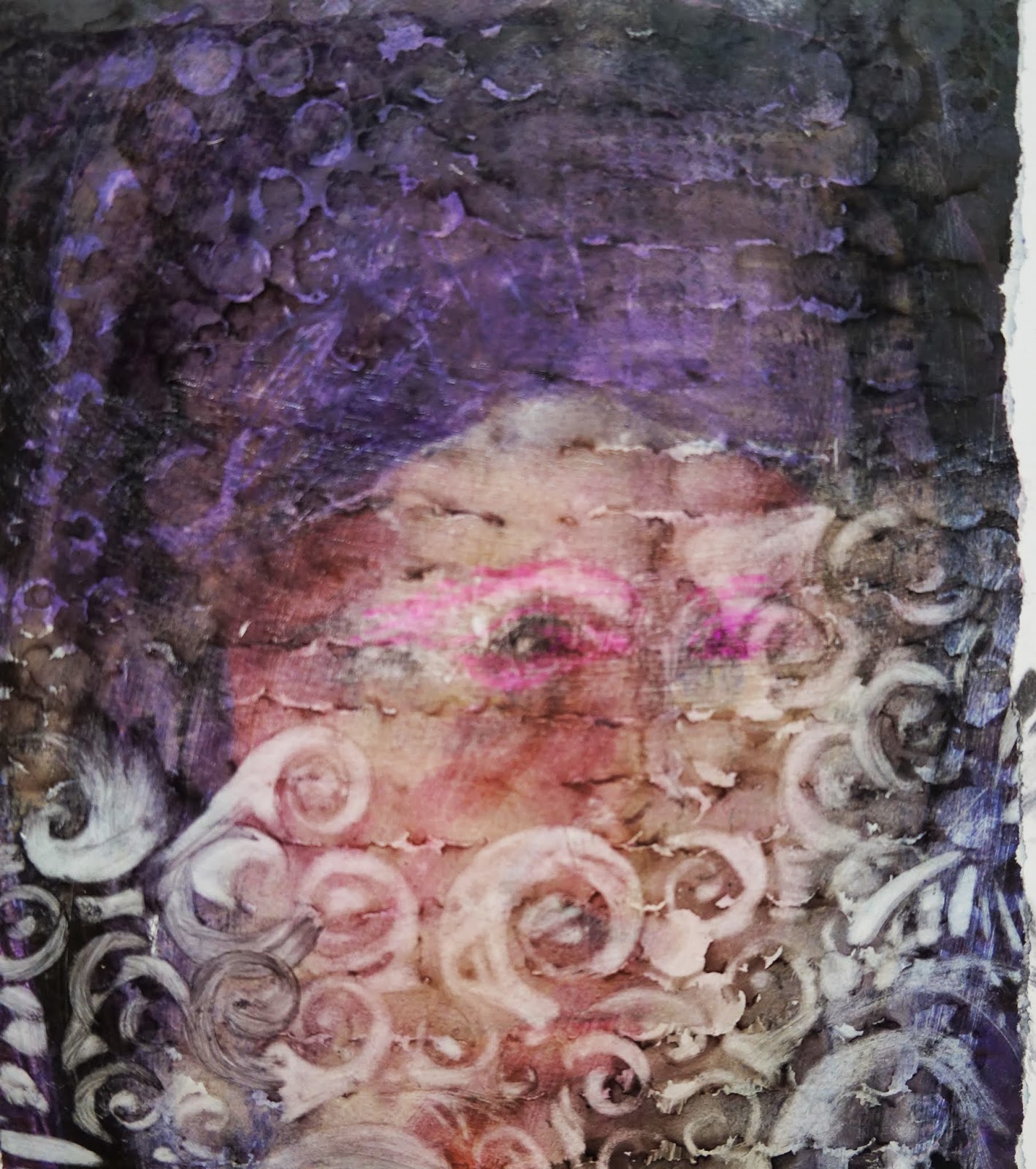
At Second Saturday club we played with collaging and painting with Citrasolv background papers. See this link for making these papers.
Simone added doilies to what remained of Liz Taylor and painted over them.
Sue C had this lovely piece where the picture still partially remained and also had dissolved colors where a stencil had been. She also added some paint to this piece.
Another piece of Sue C's. The text was a rubber stamp.
Enid put a stencil over hers and rubbed away part of the color by using Citrasolv through the stencil, applied with a Q-tip.
This is mine. The top portion was basically untouched. The bottom part was white, so I added a horizon line and color/texture to the bottom portion.
Laurie collaged with hers.
Sabyl collaged with hers too. I really like the white textured papers, which don't look like Citrasolv pages. I will have to ask her about those.
We had a lot of fun. I have about 4 more that I started that I need to work on!
Showing posts with label Second Saturday club. Show all posts
Tuesday, June 18, 2013
Tuesday, April 16, 2013
Finished Italy tin collage
For the second Saturday art club, back in March, we worked on collages/assemblages using Altoid tins. I finally completed my Italy inspired tin, here is the completed work.
For this tin I used the following items:
1. I transferred a photo of Italy using an inkjet print on transparency. I lightly misted watercolor paper with water (not soaking but very damp), and laid the transparency on top and used a brayer to help with the transfer. I glued the watercolor paper to mat board so it could be put in a shadowbox frame.
2. The gold paper was originally brown and from a discarded wallpaper book. I rubbed Golden brand gold paint on it with my fingers so the gold is on the ridges, but the recesses are still dark brown.
3. The postcard is from Italy, I had bought a huge pack of used postcards in Italy. Some had ugly pictures on the front, so I used it with the back of the card showing.
4. The tin is similar to an Altoids tin. I used a small butane torch (like the kind used to burn the sugar on creme brulee) to remove the paint and it now has a mottled black/brown color.
5. The hands were kind of like a spring loaded paper clip. I don't know where I found it. I don't know what they were originally for. I used my Dremel tool to cut the hands apart.
6. The picture is one I took in a church (it was actually in Germany, but I like the image).
7. For the decorative top, I cut a metal ring in half for my base and painted it black. I glued on jewelry charms to make the gold decoration. I tried to glue these with metal glue (similar to E6000), but they would not stay in place so I ended up using Apoxie Clay on the back side, and when it was dry I painted the clay black. I added a wire at each end bent at 90 degrees to attach the decorative top to the box. I attached it and the hands with Apoxie Clay (and painted it black when it was dry).
8. The rusty doo-dad is from a flea market.
9. The tin and the doo-dad were glued on with E6000. The paper items were glued on with Golden brand gel medium (I like mixing soft gel medium with fluid medium so it is somewhat fluid).
There you go, a ton of things went into making this piece. Some of it was done a while ago, and was just pulled out of my collection for the project ( the inkjet transfer, the burnt tin, the cut hands). Other things were done specifically for the project (the gold rubbed wallpaper, the decorative top). All the parts combine to make a great piece!
For this tin I used the following items:
1. I transferred a photo of Italy using an inkjet print on transparency. I lightly misted watercolor paper with water (not soaking but very damp), and laid the transparency on top and used a brayer to help with the transfer. I glued the watercolor paper to mat board so it could be put in a shadowbox frame.
2. The gold paper was originally brown and from a discarded wallpaper book. I rubbed Golden brand gold paint on it with my fingers so the gold is on the ridges, but the recesses are still dark brown.
3. The postcard is from Italy, I had bought a huge pack of used postcards in Italy. Some had ugly pictures on the front, so I used it with the back of the card showing.
4. The tin is similar to an Altoids tin. I used a small butane torch (like the kind used to burn the sugar on creme brulee) to remove the paint and it now has a mottled black/brown color.
5. The hands were kind of like a spring loaded paper clip. I don't know where I found it. I don't know what they were originally for. I used my Dremel tool to cut the hands apart.
6. The picture is one I took in a church (it was actually in Germany, but I like the image).
7. For the decorative top, I cut a metal ring in half for my base and painted it black. I glued on jewelry charms to make the gold decoration. I tried to glue these with metal glue (similar to E6000), but they would not stay in place so I ended up using Apoxie Clay on the back side, and when it was dry I painted the clay black. I added a wire at each end bent at 90 degrees to attach the decorative top to the box. I attached it and the hands with Apoxie Clay (and painted it black when it was dry).
8. The rusty doo-dad is from a flea market.
9. The tin and the doo-dad were glued on with E6000. The paper items were glued on with Golden brand gel medium (I like mixing soft gel medium with fluid medium so it is somewhat fluid).
There you go, a ton of things went into making this piece. Some of it was done a while ago, and was just pulled out of my collection for the project ( the inkjet transfer, the burnt tin, the cut hands). Other things were done specifically for the project (the gold rubbed wallpaper, the decorative top). All the parts combine to make a great piece!
Sunday, April 7, 2013
Gelli and gelatin printing, Second Saturday Art club
For this month's art club, we decided to do gelatin and Gelli plate printing. It's easy, it's fun, it's fast!
Some of us had Gelli plates, which are great, since you can just make prints whenever the mood strikes. These are rubbery reusable plates for monoprinting. This link is for the Gelli arts website where these can be purchased, I haven't seen them available at any craft stores. Their website also has a basic video on doing monochromatic prints, and I am sure there are videos on YouTube as well.
I have the 8" x 10" Gelli plate. For everyone else, I made gelatin for them to print on. The plate needs to be roughly 3/4" to 1" thick, so I measured how much water would fit in the pans I was using to make the gelatin. The pans differed in size, some took 4 cups of water, some took 6 cups. If I was making gelatin and using the pan that took 4 cups of water, this is the process I used. I poured 2 cups of water in the pan and stirred in 8 packets of Knox unflavored gelatin (each packet is roughly 1 tablespoon of gelatin). I stir this to get the lumps out. I would heat the other two cups of water to a boil, then add it to the pan, and stir gently until all the gelatin is dissolved. I let this rest about five minutes, then use scrap paper to drag across the top surface to remove any bubbles. The pan rests at room temperature about thirty minutes, then I put it in the frig overnight. I pulled the pan out of the frig thirty minutes before I planned to use it. To remove it from the pan, I poured about an inch of boiling water into a larger empty pan, then set the pan with gelatin in this water. I run a regular kitchen knife around the edges. The boiling water will melt some of the gelatin and it will just plop out of the pan when you flip it onto a water proof surface (we used freezer paper).
Gelatin formula: X cups of water x 2 = number of gelatin packets needed. Mix half of the water (cold) with the gelatin, then add the other half of the water (boiling) and stir gently. Rest 30 minutes, then refrigerate overnight.
Sabyl brayering her Gelli plate. Typically we would brayer the entire plate with colors, then use rubber stamps, stencils, found objects to stamp into the color. If the item was pressed into the surface without paint on the item, it would remove the color from the plate. If the item was painted first, it would add that colored pattern to the plate.
Liz at her workstation with Gayla and Laurie in the back.
We let our prints dry on plastic and newsprint in the adjacent hall, so I don't know which belong to who.
This is Simone's, she printed onto a 11x17 black and white photocopy. I love it!
These are Laurie's.
I did some on paper (mainly maps).
And on fabric.
This one is my favorite.
Gelatin printing is super fun. I did about 12 prints on fabric, and 17 on paper in roughly 3 to 4 hours. Many of these I did more than one layer of print. I would print it, let it dry, then print another layer (and some had three layers). It is a great time!
Some of us had Gelli plates, which are great, since you can just make prints whenever the mood strikes. These are rubbery reusable plates for monoprinting. This link is for the Gelli arts website where these can be purchased, I haven't seen them available at any craft stores. Their website also has a basic video on doing monochromatic prints, and I am sure there are videos on YouTube as well.
I have the 8" x 10" Gelli plate. For everyone else, I made gelatin for them to print on. The plate needs to be roughly 3/4" to 1" thick, so I measured how much water would fit in the pans I was using to make the gelatin. The pans differed in size, some took 4 cups of water, some took 6 cups. If I was making gelatin and using the pan that took 4 cups of water, this is the process I used. I poured 2 cups of water in the pan and stirred in 8 packets of Knox unflavored gelatin (each packet is roughly 1 tablespoon of gelatin). I stir this to get the lumps out. I would heat the other two cups of water to a boil, then add it to the pan, and stir gently until all the gelatin is dissolved. I let this rest about five minutes, then use scrap paper to drag across the top surface to remove any bubbles. The pan rests at room temperature about thirty minutes, then I put it in the frig overnight. I pulled the pan out of the frig thirty minutes before I planned to use it. To remove it from the pan, I poured about an inch of boiling water into a larger empty pan, then set the pan with gelatin in this water. I run a regular kitchen knife around the edges. The boiling water will melt some of the gelatin and it will just plop out of the pan when you flip it onto a water proof surface (we used freezer paper).
Gelatin formula: X cups of water x 2 = number of gelatin packets needed. Mix half of the water (cold) with the gelatin, then add the other half of the water (boiling) and stir gently. Rest 30 minutes, then refrigerate overnight.
Sabyl brayering her Gelli plate. Typically we would brayer the entire plate with colors, then use rubber stamps, stencils, found objects to stamp into the color. If the item was pressed into the surface without paint on the item, it would remove the color from the plate. If the item was painted first, it would add that colored pattern to the plate.
Liz at her workstation with Gayla and Laurie in the back.
We let our prints dry on plastic and newsprint in the adjacent hall, so I don't know which belong to who.
This is Simone's, she printed onto a 11x17 black and white photocopy. I love it!
These are Laurie's.
I did some on paper (mainly maps).
And on fabric.
This one is my favorite.
Gelatin printing is super fun. I did about 12 prints on fabric, and 17 on paper in roughly 3 to 4 hours. Many of these I did more than one layer of print. I would print it, let it dry, then print another layer (and some had three layers). It is a great time!
Monday, March 18, 2013
Altered altoid tins, 2nd Saturday club
This month, our 2nd Saturday Art Club got together on 3rd Sunday instead. We altered tins (altoid and other tins). We had a great time as usual!
Here is Laurie and her round tin and the start of a house assemblage. Susan had wood house shapes to share, which I loved!
Here is the start of Sabyl's tin.
Susan and her "lady". I love the metal faucet handle thing on top.
Here are Enid and Trisha working on their pieces.
Enid's faces.
Trisha's Van Gogh inspired sea scape.
Newcomer Liz is working on her tin. She had papered it, then had technical difficulties. I think she still enjoyed the camaraderie and craziness that is 2nd Saturday group!
Here is a piece I have in progress. I still need to glue everything down and I have a decorative piece for the top of the tin.
Here is the piece I made with Susan's house shape. The kid photos are me and my sister. The transparency in the tin is our childhood house in Toledo, OH. The bottom portion is a Diet Coke can that I ran through my die cutting machine with an embossing plate (Tim Holtz plate, I believe) and inked with Staz On.
It was a fun time, and we stayed for over five hours! A great way to spend a day!
Here is Laurie and her round tin and the start of a house assemblage. Susan had wood house shapes to share, which I loved!
Here is the start of Sabyl's tin.
Susan and her "lady". I love the metal faucet handle thing on top.
Here are Enid and Trisha working on their pieces.
Enid's faces.
Trisha's Van Gogh inspired sea scape.
Newcomer Liz is working on her tin. She had papered it, then had technical difficulties. I think she still enjoyed the camaraderie and craziness that is 2nd Saturday group!
Here is a piece I have in progress. I still need to glue everything down and I have a decorative piece for the top of the tin.
Here is the piece I made with Susan's house shape. The kid photos are me and my sister. The transparency in the tin is our childhood house in Toledo, OH. The bottom portion is a Diet Coke can that I ran through my die cutting machine with an embossing plate (Tim Holtz plate, I believe) and inked with Staz On.
It was a fun time, and we stayed for over five hours! A great way to spend a day!
Wednesday, February 27, 2013
Black and White Heart Assemblage
Taking up where I left off here, I finally glued down all the parts and pieces and stamped "you have my" on the left side. I may add some white accents, maybe dry brush some white on the textured frame.
Monday, February 11, 2013
Mixed Media heart, 2nd Saturday art club, heart and non-heart collages
For the Colorado Mixed Media 2nd Saturday meeting, we worked on the metal heart collages that I posted about previously. A lot of people in the group talked about using a canvas backwards to frame the heart (via email before the meeting) so I thought I'd bring one for my collage as well.
When I use a canvas backwards, most of the time I will apply crinkled tissue paper to it to hide the staples and where the canvas material stops. I decided to do this before the meeting to save some time.
When I apply the tissue paper, I start by covering the gap between the canvas and the frame. I usually use un-crinkled tissue paper for that part. I apply gel medium (I used liquid gel medium, but soft gel or regular gel will work too) to the frame/canvas, put the tissue paper on it, then apply more medium on top.
Then I start crinkling the tissue paper and applying it over the whole back and sides with gel medium.
I keep applying more tissues paper until I feel the staples and seams are hidden, I would say this piece has up to three layers in some places. I used about a sheet and a half of tissue paper.
I used black gesso to cover the tissue paper, but did one strip of white gesso where I plan to overlay some stamped tissue paper. I did one coat of acrylic paint, mainly black with a little ultramarine mixed in.
While I had my tissue paper out, I stamped a circle stamp onto a tissue paper for my accent strip. It was good to do all this prep ahead of time so I was not spending my time during our group meeting waiting for things to dry.
At our group meet, I demoed applying Ranger Patina inks and alcohol inks to the metal hearts. This is shown in my previous post here.
I wanted to try putting white gesso on the raised parts of the heart, then apply black alcohol ink over the whole thing, and rinse it with water in the hopes that the ink would wash off the gesso. I should have used guache but I forgot to bring it and this did not really work.
I was using Jacquard Pinata Color alcohol inks and assumed there was a black in the set, but there wasn't. I mixed my own on a disposable plate using red, blue, purple, brown and yellow. It looks pretty black, but leans towards purple. Below, the heart on the left is alcohol ink only. The heart on the right is ink over gesso. (I would have used my Black Staz On refill, but did not have it with me).
The heart on the top is the one that had gesso under the ink. I sanded it and then tried to apply more white gesso on top, but it is just a hot mess. I plan to paint it glossy red. The heart on the bottom was first covered with alcohol inks, then I applied the Ranger patina (comes in a three pack with a yellow-green, green, and turquoise) just on the raised parts. It turned out great.
Everyone in group played with their metal hearts, but in the end, a lot of the collages did not include them. Here is Gayla (I hope that is spelled correctly) with her collage piece. She was able to use some of my leftover stamped circles.
Close-up.
Here is Sabyl and her piece in progress. She had a field day earlier in the week making hand painted (and super yummy colored) tissue papers which she included in her piece.
Susan with her work in progress.
Enid layered hers with some printed clear mylar.
Let them eat cake! Here is Laurie with her queen piece.
Here is my work in progress. I still have some things to do and need to glue everything down. This heart is the one with the "black" alcohol ink only, which I sanded to remove the ink from the raised surfaces. I plan to stamp "you have my" on the black circle tissue paper (which I should have done before glueing it to the bumpy tissue paper background, oops!) and add some more details.
We had a great time and it was great to make it to (and teach) the meeting as I have missed quite a few lately. I hope Gayla can make it next month since this is her first meeting.
When I use a canvas backwards, most of the time I will apply crinkled tissue paper to it to hide the staples and where the canvas material stops. I decided to do this before the meeting to save some time.
When I apply the tissue paper, I start by covering the gap between the canvas and the frame. I usually use un-crinkled tissue paper for that part. I apply gel medium (I used liquid gel medium, but soft gel or regular gel will work too) to the frame/canvas, put the tissue paper on it, then apply more medium on top.
Then I start crinkling the tissue paper and applying it over the whole back and sides with gel medium.
I keep applying more tissues paper until I feel the staples and seams are hidden, I would say this piece has up to three layers in some places. I used about a sheet and a half of tissue paper.
I used black gesso to cover the tissue paper, but did one strip of white gesso where I plan to overlay some stamped tissue paper. I did one coat of acrylic paint, mainly black with a little ultramarine mixed in.
While I had my tissue paper out, I stamped a circle stamp onto a tissue paper for my accent strip. It was good to do all this prep ahead of time so I was not spending my time during our group meeting waiting for things to dry.
At our group meet, I demoed applying Ranger Patina inks and alcohol inks to the metal hearts. This is shown in my previous post here.
I wanted to try putting white gesso on the raised parts of the heart, then apply black alcohol ink over the whole thing, and rinse it with water in the hopes that the ink would wash off the gesso. I should have used guache but I forgot to bring it and this did not really work.
I was using Jacquard Pinata Color alcohol inks and assumed there was a black in the set, but there wasn't. I mixed my own on a disposable plate using red, blue, purple, brown and yellow. It looks pretty black, but leans towards purple. Below, the heart on the left is alcohol ink only. The heart on the right is ink over gesso. (I would have used my Black Staz On refill, but did not have it with me).
The heart on the top is the one that had gesso under the ink. I sanded it and then tried to apply more white gesso on top, but it is just a hot mess. I plan to paint it glossy red. The heart on the bottom was first covered with alcohol inks, then I applied the Ranger patina (comes in a three pack with a yellow-green, green, and turquoise) just on the raised parts. It turned out great.
Everyone in group played with their metal hearts, but in the end, a lot of the collages did not include them. Here is Gayla (I hope that is spelled correctly) with her collage piece. She was able to use some of my leftover stamped circles.
Close-up.
Here is Sabyl and her piece in progress. She had a field day earlier in the week making hand painted (and super yummy colored) tissue papers which she included in her piece.
Susan with her work in progress.
Enid layered hers with some printed clear mylar.
Let them eat cake! Here is Laurie with her queen piece.
Here is my work in progress. I still have some things to do and need to glue everything down. This heart is the one with the "black" alcohol ink only, which I sanded to remove the ink from the raised surfaces. I plan to stamp "you have my" on the black circle tissue paper (which I should have done before glueing it to the bumpy tissue paper background, oops!) and add some more details.
We had a great time and it was great to make it to (and teach) the meeting as I have missed quite a few lately. I hope Gayla can make it next month since this is her first meeting.
Subscribe to:
Posts (Atom)